
Dental Implant vs Bridge vs Denture: Which Is Right for Your Missing Tooth?
 Dr. Kavita Bhat Kumar10 min read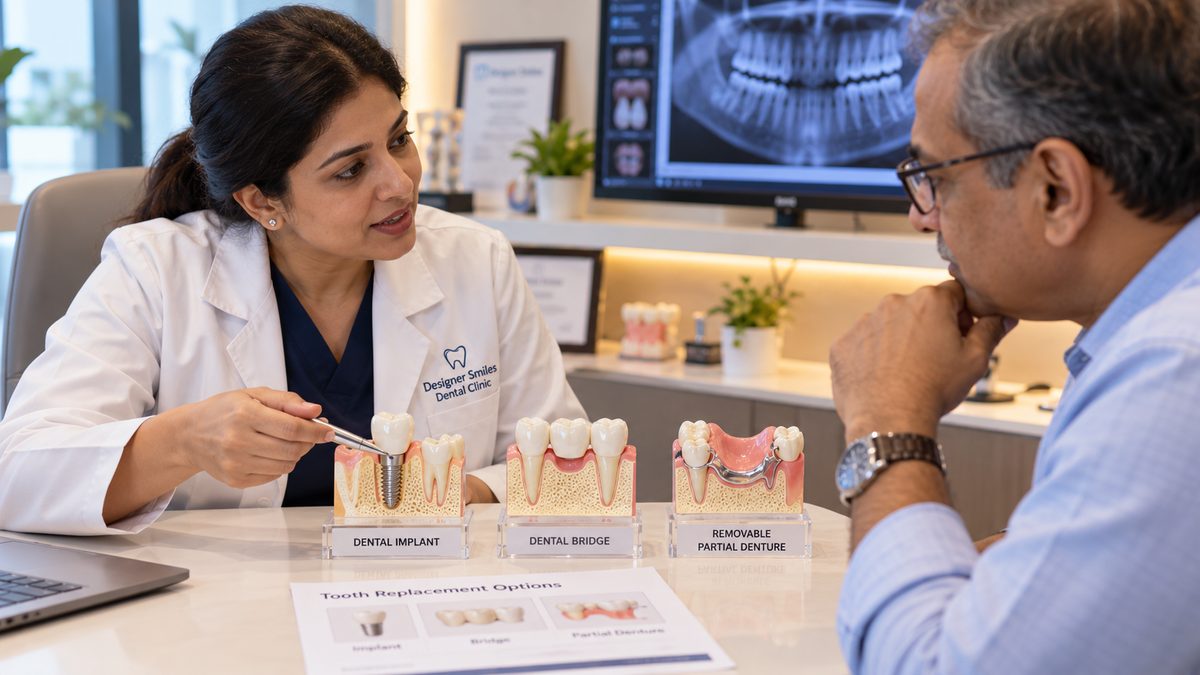
In this guide
- The short answer
- Why you should not leave the gap empty
- Option 1: Dental implant
- Option 2: Dental bridge
- Option 3: Denture
- Side by side comparison
- What about cost over time?
- When a bridge might actually be the better choice
- When a denture makes sense
- The middle path for many missing teeth
- Common worries about implants
- Why patients from Vile Parle and nearby choose Designer Smiles for implants
- Not sure which option is right for you?
Losing a tooth is more common than people admit. A cracked molar that could not be saved. A front tooth lost in an accident. Gum problems that slowly loosened a tooth over the years.
Whatever the reason, the next question is always the same. "What should I replace it with?"
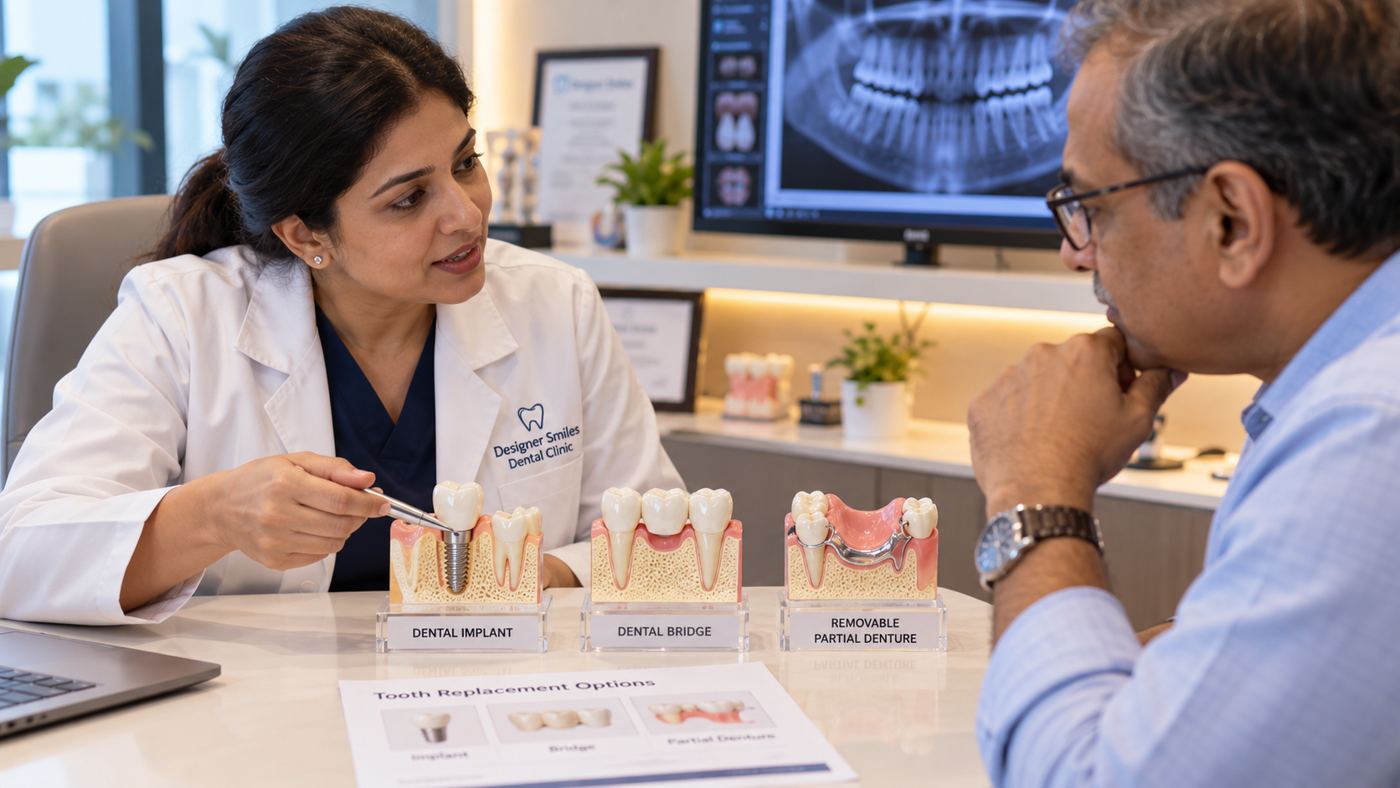
You have three main choices: a dental implant, a bridge, or a denture. Each one works. Each one has a place. But they are very different in cost, comfort, how long they last, and what they do to the rest of your mouth.
This guide puts them side by side, in plain language, so you can walk into your consultation already knowing what to ask.
The short answer
- Dental implant: the closest thing to a natural tooth. Does not touch the teeth next to it. Lasts the longest. Costs more up front. At Designer Smiles, implants start from ₹30,000 per implant.
- Bridge: fixed, quicker, and lower cost at the start. But the healthy teeth on both sides have to be shaped down to hold it.
- Denture: removable and the lowest cost. Good for many missing teeth, but can feel loose and does not stop bone loss.
For most healthy adults missing one tooth, an implant is usually the best long term choice. But not always, and we will explain when the other two make more sense.
Why you should not leave the gap empty
Many people think, "It is a back tooth, nobody can see it." Fair. But a gap does more than change how you look.
- The teeth next to the gap start tilting into the empty space.
- The tooth above or below can slowly grow into the gap, because nothing is stopping it.
- Your bite changes, which can put extra load on other teeth.
- The jawbone in that spot shrinks over time, because there is no root to keep it active.
- Chewing becomes harder on one side, so you start using the other side more.
The longer a gap stays, the more these small changes add up. And bone loss in particular can make an implant more complicated later.
Option 1: Dental implant
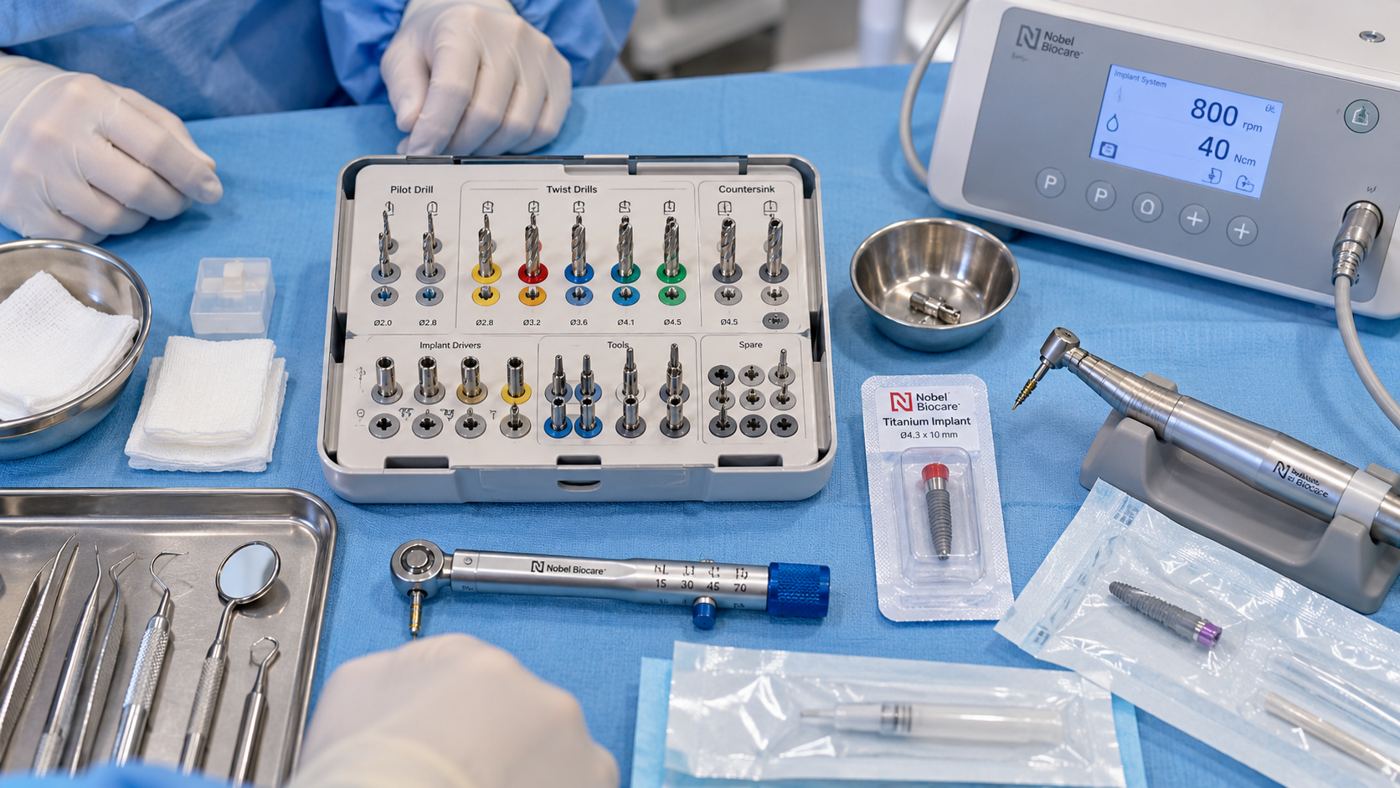
A dental implant is a small titanium post placed in the jawbone. It works like a new root. Once it heals and bonds with the bone, a crown is fixed on top.
What is good about it
- Looks and feels like a real tooth. Most people forget which one is the implant.
- Neighbouring teeth stay untouched. Nothing is cut or shaped.
- Protects your jawbone, because it acts like a natural root.
- Lasts a very long time. With good care, implants can last decades. Studies commonly report survival rates above 95% at ten years.
- Easy to clean. Brush and floss like a normal tooth.
What to know
- Higher upfront cost than a bridge or denture.
- Takes time. Usually 3 to 6 months from start to final crown, as the bone needs to heal.
- Needs enough bone. If bone is thin, a bone graft or sinus lift may be needed first.
- Small procedure. It is done under local anaesthesia, and most people say it was easier than they expected.
At Designer Smiles, implants are planned with digital imaging and placed using established systems like Nobel Biocare® and Straumann®, chosen based on your case. Where clinically suitable, we use flapless placement, which avoids cutting the gum and stitches. In some cases, an immediate implant can be placed on the same day the tooth is removed.
Learn more on our dental implants page.
Option 2: Dental bridge
A bridge fills the gap using the teeth on either side as support. Those two teeth are shaped down and covered with crowns, and a false tooth sits in the middle, joined to them.
What is good about it
- Fixed in place. It does not come out.
- Faster. Usually done in a couple of weeks.
- No surgery.
- Lower cost at the start than an implant.
What to know
- Healthy teeth have to be cut down. This is the big one. If the teeth next to the gap are perfectly healthy, you are trading good enamel for the bridge. That cannot be undone.
- Harder to clean. You need special floss or a threader to clean under the false tooth.
- Does not stop bone loss under the missing tooth.
- Shorter lifespan. Bridges often need replacing after around 10 to 15 years. If one of the support teeth gets decay or fails, the whole bridge may need to be redone.
In Mumbai, a three unit bridge (one missing tooth plus two supports) commonly costs roughly ₹15,000 to ₹35,000, depending on the material.
Option 3: Denture
A denture is a removable plate with false teeth. A partial denture replaces a few teeth. A complete denture replaces a full arch.
What is good about it
- Lowest cost of the three.
- No surgery and no cutting of teeth.
- Can replace many teeth at once.
What to know
- Can feel loose, especially lower dentures. Some people struggle with eating and speaking clearly.
- Needs to be taken out and cleaned every day.
- Does not stop bone loss. Over time the jaw shrinks, so dentures need relining or remaking.
- Chewing strength is lower than natural teeth or implants.
Side by side comparison
| Dental implant | Bridge | Denture | |
|---|---|---|---|
| Fixed or removable | Fixed | Fixed | Removable |
| Touches healthy teeth? | No | Yes, shapes teeth on both sides | Rests on teeth or gums |
| Protects jawbone | Yes | No | No |
| Feels natural | Very close to a real tooth | Good | Takes getting used to |
| Chewing | Strong | Good | Weaker |
| Cleaning | Like a normal tooth | Needs special flossing | Remove and clean daily |
| Typical lifespan | Decades with good care | Around 10 to 15 years | Around 5 to 10 years, often needs relining |
| Time to complete | 3 to 6 months | 1 to 3 weeks | 2 to 4 weeks |
| Upfront cost | Highest | Medium | Lowest |
| Long term value | Usually the best | Medium | Lowest upfront, but frequent upkeep |
Swipe to see more →
What about cost over time?
This is where a lot of people change their mind.
A bridge looks cheaper on day one. But it often needs replacing at least once over 20 years, sometimes with extra work on the support teeth. Dentures need relining and remaking as the jaw changes.
An implant usually costs more once, and then mainly needs regular check-ups and good brushing. The crown on top may need replacing after many years of wear, but the implant itself is designed to stay.
So the real question is not "which is cheapest today?" It is "which will I be happiest with in ten or fifteen years?"
When a bridge might actually be the better choice
We are not here to push implants on everyone. A bridge can be the smarter option when:
- The teeth next to the gap already have large fillings or crowns, so shaping them is not a big loss
- You have a medical condition that makes implant surgery unsafe
- There is not enough bone and you do not want grafting
- You need the gap filled quickly, for example before an event
When a denture makes sense
- You are missing many teeth and budget is tight
- You want a temporary solution while you plan implants
- Your general health makes surgery a poor idea
The middle path for many missing teeth
If you are missing most or all of your teeth, you do not have to choose between a loose denture and an implant for every single tooth.
- Implant-supported dentures clip firmly onto a few implants, so they stay put while you eat and laugh. From ₹1 lakh per arch.
- All-on-4 dental implants give you a full fixed set of teeth on four implants. From ₹1.5 lakh per arch.
- All-on-6 dental implants use six implants for extra support. From ₹2 lakh per arch.
Common worries about implants
"I am too old for an implant."
Age alone is rarely the problem. What matters is your general health, your gums and the bone in your jaw. Many people in their 60s and 70s get implants and do very well.
"I have diabetes."
Well controlled diabetes does not usually rule out implants. Your dentist will check your health history and may work with your doctor.
"I smoke."
Smoking slows healing and raises the risk of implant problems. Cutting down or stopping, at least around the time of treatment, gives the implant a much better chance.
"I am scared it will hurt."
This is the most common fear, and it is normal. Implants are placed under local anaesthesia, so the area is fully numb. Most people describe mild soreness for a day or two, often less than a tooth extraction. At Designer Smiles, you can also use our Signature Comfort Menu: noise-cancelling earphones, your own music, an eye mask and a warm towel and neck massage afterwards.
Why patients from Vile Parle and nearby choose Designer Smiles for implants
- 30+ years of experience. Dr. Kavita Bhat Kumar has been treating patients in Vile Parle East since 1995. She is a Life Member of the Indian Society of Oral Implantologists (ISOI) and was featured in Forbes India in 2026.
- Established implant brands. Nobel Biocare® and Straumann®, chosen based on your needs.
- Minimally invasive approach. Flapless placement where suitable, which can mean less swelling.
- Strong, natural crowns. Precision BruxZir® zirconia crowns when clinically appropriate.
- Strict sterilisation. ISO 9001:2015 certified clinic with a dedicated sterilisation area.
- A full specialist team under one roof, including a prosthodontist and periodontist.
- Easy to reach. Close to Vile Parle station, the Western Express Highway and Mumbai's international airport. Patients come from Andheri, Santacruz, Juhu, Bandra and beyond.
Not sure which option is right for you?
That is exactly what a consultation is for. We will check your teeth, gums and bone with digital imaging, explain every option honestly, including the ones that cost less, and give you a clear, written cost.
Designer Smiles
Shop No. 5, Samikaran, Sant Janabai Road, Off Hanuman Road, Vile Parle East, Mumbai 400057
Phone and WhatsApp: +91 98212 43274
Open 7 days, 10 AM to 8 PM
Book a consultation or message us on WhatsApp
Related reading: Dental Implants in Mumbai: Cost, Types, Success Rate and What to Actually Expect · Scared of the Dentist? 9 Ways to Make Your Next Visit Easier
This article is for general information. Every mouth is different, so please get a personal examination before starting any treatment.
Frequently Asked Questions about Implants, Bridges and Dentures
For most healthy adults missing one tooth, an implant is the better long term option. It does not damage the neighbouring teeth, protects the jawbone and usually lasts much longer. A bridge can be better if the teeth beside the gap already need crowns, or if surgery is not suitable for you.
At Designer Smiles, dental implants start from ₹30,000 per implant. The final cost depends on the implant brand, the type of crown, and whether bone grafting is needed. You get a written cost after your consultation.
With good brushing, flossing and regular check-ups, implants can last decades, often a lifetime. The crown on top may need replacing after many years.
Most bridges last around 10 to 15 years, depending on care and the health of the support teeth.
For comfort, chewing and protecting the jawbone, yes. Implants do not move or slip. Dentures cost less and need no surgery, so they still suit some people, especially when many teeth are missing and budget is a concern.
Often, yes. But the jawbone shrinks over time, so you may need a bone graft first. The sooner you replace a missing tooth, the simpler the treatment usually is.
In suitable cases, yes. This is called an immediate implant. Your dentist will check bone and gum health to see if it is right for you.
The procedure is done under local anaesthesia, so you should not feel pain during it. Most people have mild soreness for a day or two that is easily managed.
Talk to Dr. Kavita about your smile.
Dr. Kavita Bhat Kumar
Founder, Designer Smiles · 30+ years of clinical experience
Trained in aesthetic dentistry in Germany, Dr. Kavita has been caring for patients in Vile Parle East since 1995.
About Dr. Kavita →Keep reading

Dental Implants
Dental Implants in Mumbai: Cost, Types, Success Rate and What to Actually Expect
If you are reading this, there is a good chance you have a gap in your smile, a tooth that is about to be removed, or a denture that has never quite felt right. You have probably also heard three very different things about dental implants: that they are the best tooth replacement available, that they are painful, and that they cost a fortune.
28 September 2026 · 11 min read
Cosmetic Dentistry
Veneers Cost in Mumbai: Porcelain vs Composite vs E.max, Explained Simply
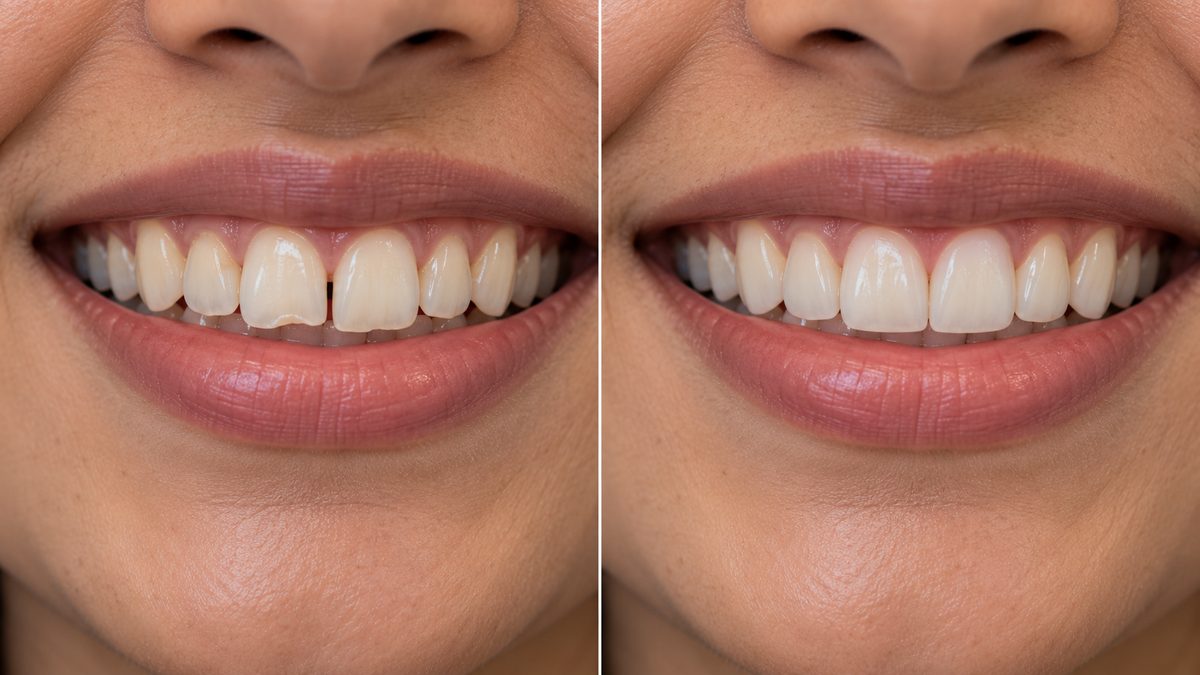
Veneers are probably the most searched cosmetic dental treatment in India right now. Part of it is social media. Part of it is that people are finally realising they do not have to live with a chipped front tooth or a gap they have hidden in photos for ten years.
16 October 2026 · 10 min read
Orthodontics
Invisalign Cost in Mumbai: What You Will Really Pay, and Is It Better Than Braces?
You searched for the price of Invisalign. You got five websites and seven different numbers. One clinic says ₹80,000. Another says ₹3.5 lakh. A third just says "call us."
16 October 2026 · 10 min read

Cosmetic Dentistry
Smile Makeover in Mumbai: Treatments, Cost, Timeline and How to Plan Yours
Most people who come in asking about a smile makeover start the conversation the same way. "It's not a big problem, but…" and then they point to it. A chipped front tooth. A gap they have hidden in photos since college.
28 September 2026 · 11 min read