
Dental Implants in Mumbai: Cost, Types, Success Rate and What to Actually Expect
 Dr. Kavita Bhat KumarSeptember 202611 min read
In this guide
- Why a Missing Tooth Is More Than a Gap
- What Exactly Is a Dental Implant?
- How Long Do Dental Implants Last? What the Research Says
- Types of Dental Implants: Which One Is Right for You?
- Dental Implant Cost in Mumbai (2026)
- Are You a Good Candidate for Dental Implants?
- What the Implant Process Actually Feels Like
- Implants vs Bridges vs Dentures: An Honest Comparison
- How to Choose the Right Implant Dentist in Mumbai
- The Bottom Line
If you are reading this, there is a good chance you have a gap in your smile, a tooth that is about to be removed, or a denture that has never quite felt right. You have probably also heard three very different things about dental implants: that they are the best tooth replacement available, that they are painful, and that they cost a fortune.
The truth sits somewhere more useful. Implants are one of the most studied treatments in dentistry, they are far more comfortable than most people expect, and the cost in Mumbai is often lower than people assume once you understand what you are paying for.
This guide walks you through everything, in plain language: what happens when a tooth is missing, what the research says about how long implants last, the different types of implants, realistic prices in Mumbai, and how to tell whether you are a good candidate.
Why a Missing Tooth Is More Than a Gap
Most people think of a missing tooth as a cosmetic problem, especially if it is at the back of the mouth where nobody sees it. But the jawbone does not see it that way.
Your jawbone stays strong because the roots of your teeth stimulate it every time you chew. When a tooth is removed, that stimulation stops, and the bone starts to shrink. The numbers are sobering. A systematic review of human studies found that within just six months of an extraction, the jaw loses 29 to 63 percent of its width and 11 to 22 percent of its height at that spot. Most of this loss happens in the first three to six months.
This matters for three practical reasons:
- Neighbouring teeth start to drift. Teeth on either side slowly tilt into the gap, and the tooth above or below can start to grow out of its socket. Your bite changes over time.
- Future treatment becomes harder. The longer you wait, the less bone is left, and the more likely you are to need a bone graft before an implant can be placed.
- Your face changes. When several teeth are missing, the lips and cheeks lose support. This is why people who have lost many teeth often look older than they are.
Tooth loss is also far more common than most people realise. In a large WHO-supported study of adults aged 50 and above, 15.3 percent of people in India had lost all their natural teeth, compared with 8.9 percent in China. Behind that number are millions of Indians eating softer food than they want to, avoiding photos, and putting up with loose dentures.
The good news is that a dental implant is the only tooth replacement that actually replaces the root, and so helps protect the bone that is left.
What Exactly Is a Dental Implant?
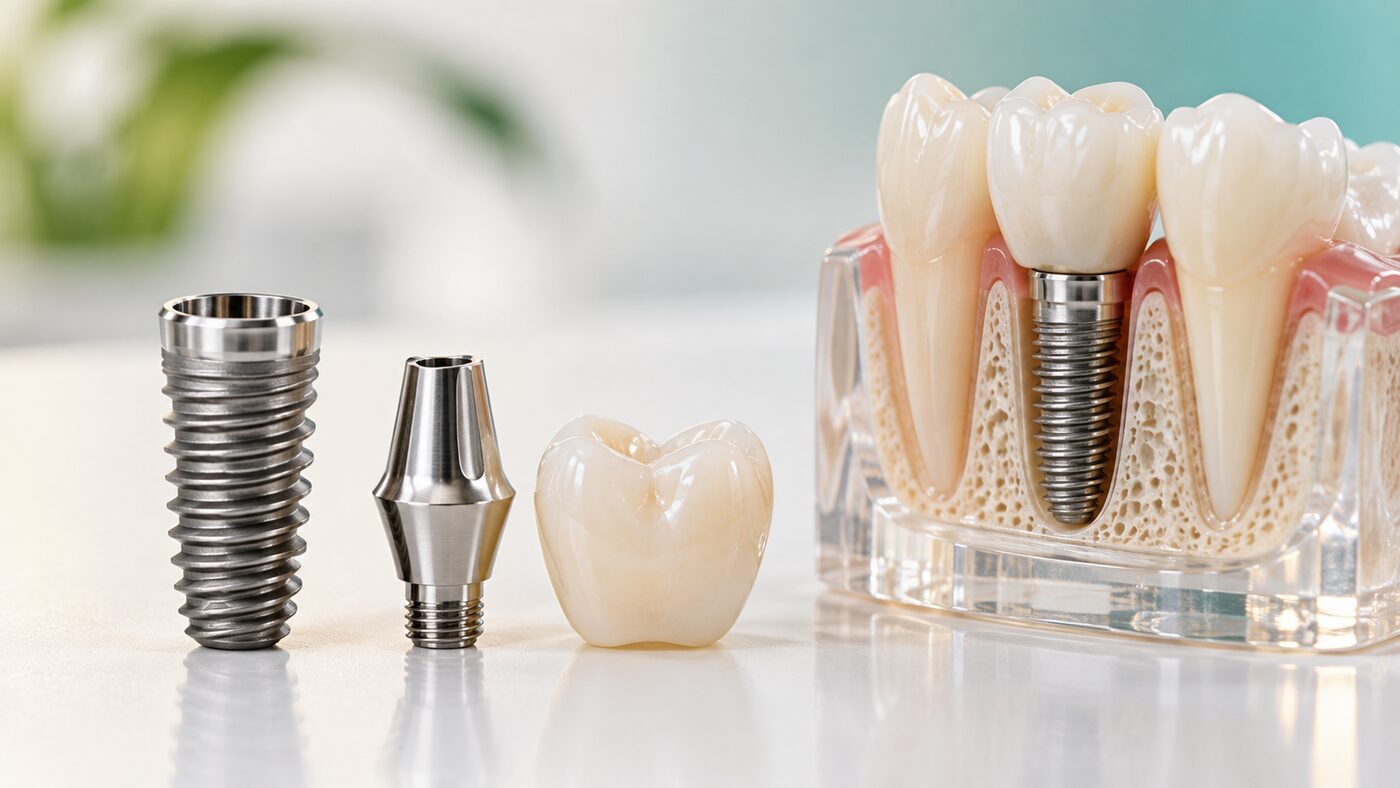
A dental implant has three parts:
- The implant: a small screw-shaped post, usually made of titanium, that is placed in the jawbone where the root used to be.
- The abutment: a connector that sits on top of the implant, just above the gum.
- The crown: the visible tooth, custom-made to match your other teeth. At Designer Smiles, this is usually a precision zirconia crown.
Over the healing period, the bone grows tightly around the implant surface. This process is called osseointegration, and it is what makes an implant feel solid, like a natural tooth, rather than something sitting on top of your gums.
You can read the full treatment overview on our dental implants page.
How Long Do Dental Implants Last? What the Research Says
This is the question almost every patient asks, and it deserves a real answer rather than "a lifetime".
The best-quality evidence comes from systematic reviews, which combine the results of many long-term studies. A 2019 systematic review and meta-analysis looked at modern implants followed for at least ten years and found a 10-year survival rate of 96.4 percent. In simple words, roughly 96 out of every 100 implants were still in place and working after a decade.
What about longer? A 2024 meta-analysis of 20-year data is one of the first to look that far ahead. Prospective studies showed a mean 20-year survival of about 92 percent. When the researchers used a stricter method that accounted for patients who dropped out of follow-up, the estimate came down to about 78 percent, which the authors summarised as roughly four out of five implants lasting 20 years.
Two honest points come out of this research:
- Implants are very reliable, but not indestructible. The same 2019 review found that people aged 65 and above had a noticeably higher risk of implant loss in the more cautious analysis. Age alone does not rule anyone out, but it does mean planning and follow-up matter more.
- What you do after treatment counts. Smoking, uncontrolled diabetes, poor cleaning around the implant, and heavy teeth grinding are the most common reasons implants run into problems. A night guard and regular check-ups go a long way.
Compare this with a traditional bridge, which needs the healthy teeth on both sides to be shaved down to support it, or a removable denture, which does nothing to slow bone loss. For most people who are suitable, an implant is the longest-lasting option.
Types of Dental Implants: Which One Is Right for You?
"Dental implant" is not a single treatment. The right type depends on how many teeth are missing, how much bone you have, and how quickly you need a tooth back. Here are the main options available at Designer Smiles.
1. Single-Stage Implants
The implant is placed in one surgery, with a small healing cap that sits just above the gum. There is no second procedure to uncover it later. This suits people with healthy gums and good bone, and it usually means fewer visits. Learn about single-stage implants.
2. Two-Stage Implants
The implant is placed and fully covered by the gum while it heals, then uncovered in a short second procedure. This is the most widely studied method, and it is usually the safer choice when bone grafting or a sinus lift is needed, or when the bone is thin. Learn about two-stage implants.
3. Immediate Implants (Tooth in 24 Hours)
The damaged tooth is removed, the implant is placed in the same sitting, and in suitable cases a fixed temporary tooth is attached within 24 hours. It is especially popular for front teeth, because nobody wants to walk around with a gap for months. Not everyone qualifies, and a careful dentist will tell you so. Learn about immediate implants.
4. All-on-4 Dental Implants
A complete arch of fixed teeth is supported on just four implants. The back two implants are angled to make the best use of the bone at the front of the jaw, which means many people who were told they "do not have enough bone" can still get fixed teeth, often without grafting. Learn about All-on-4.
5. All-on-6 Dental Implants
The same idea as All-on-4, but with six implants per arch. The extra two implants share the chewing load, which helps people with a strong bite, a grinding habit, or a larger jaw. It usually needs more bone. Learn about All-on-6.
6. Implant-Supported Dentures
A removable denture that clicks firmly onto two to four implants. It stops a loose denture from slipping, costs less than fully fixed teeth, and is very popular with older patients. Learn about implant-supported dentures.
Quick comparison
| Option | Best for | Fixed or removable | Typical timeline |
|---|---|---|---|
| Single-stage implant | One or a few missing teeth, healthy bone | Fixed | About 2 to 4 months |
| Two-stage implant | Thin bone, grafting, front teeth | Fixed | About 4 to 6 months, longer with grafting |
| Immediate implant | A tooth that needs removal, front teeth | Fixed | Temporary tooth in 24 hours, final crown in 3 to 4 months |
| All-on-4 | All teeth missing or failing in one jaw | Fixed | Temporary teeth in days, final teeth in 3 to 6 months |
| All-on-6 | Full arch, good bone, strong bite | Fixed | About 4 to 6 months |
| Implant-supported denture | Loose dentures, tighter budget | Removable | About 3 to 5 months |
Swipe to see more →

Dental Implant Cost in Mumbai (2026)
Let us talk about money directly, because vague answers are frustrating.
At Designer Smiles, the starting prices are:
| Treatment | Starting price |
|---|---|
| Single dental implant | From ₹30,000 per implant |
| Implant-supported dentures | From ₹1 Lakh per arch |
| All-on-4 dental implants | From ₹1.5 Lakh per arch |
| All-on-6 dental implants | From ₹2 Lakh per arch |
Swipe to see more →
The final cost of your treatment depends on a few things:
- The implant system. Different brands have different research track records, warranties, and prices.
- The crown. A zirconia crown costs more than a basic metal-ceramic one, but looks and lasts better.
- Extra procedures. Bone grafting or a sinus lift adds to the cost when your bone needs building up.
- Number of implants. More implants mean more components and surgical time.
- Full-arch material. For All-on-4 and All-on-6, the material of the final bridge makes a real difference to the price.
Three money tips that save patients real regret:
- Always ask what the quoted price includes. Is it the implant only, or implant plus abutment plus crown? A low headline price that excludes the crown is not a low price.
- Ask which implant brand will be used. A reputable clinic will tell you without hesitation.
- Think in cost per year, not just total cost. An implant that lasts 15 to 20 years or more often works out cheaper over time than a bridge or denture that needs replacing.
At Designer Smiles, you get a clear, written cost after your consultation and scan, with no hidden charges. You can see all treatment prices on our treatments page.
Are You a Good Candidate for Dental Implants?
Most adults who are missing one or more teeth can have implants. You are likely to be a good candidate if:
- You are in reasonably good general health.
- Your gums are healthy, or can be treated first.
- You have enough bone, or are open to grafting if needed.
- Any diabetes or blood pressure is well controlled.
- You are willing to keep the area clean and come for check-ups.
Implants may need more careful planning if you smoke heavily, have uncontrolled diabetes, take certain bone medicines, or have had radiation to the jaw. None of these automatically rule you out, but they need to be discussed honestly before treatment.
"I have been told I do not have enough bone" is one of the most common things we hear. In many of these cases, All-on-4 or a two-stage implant with grafting can still make implants possible. It is always worth a second opinion with a proper scan.
What the Implant Process Actually Feels Like
Here is the part most people worry about the most.
Is it painful? The procedure is done under local anaesthesia, so the area is completely numb. You feel pressure and vibration, not pain. Most patients compare placing a single implant to having a tooth filled or removed. Afterwards, some soreness and swelling for two to three days is normal, and most people go back to work the next day.
How long does it take? A single implant is usually placed in under an hour. The full treatment, from implant to final crown, takes anywhere from a few weeks to several months depending on the type of implant and whether grafting is needed.
Will I have a gap while it heals? If the tooth is visible when you smile, a temporary tooth can almost always be arranged, or an immediate implant may be possible.
At Designer Smiles, we also think the experience around the procedure matters. During treatment you can choose from our Signature Comfort Menu: noise-cancelling earphones and your own music, a fleece blanket, an eye mask, and a stress ball to hold. After surgery, there is a warm towel, a gentle neck massage, and ice cream to keep the area cool. It sounds like a small thing until you are the one in the chair.
Implants vs Bridges vs Dentures: An Honest Comparison
| Dental Implant | Bridge | Removable Denture | |
|---|---|---|---|
| Replaces the root | Yes | No | No |
| Helps protect jawbone | Yes | No | No |
| Affects neighbouring teeth | No | Yes, they are shaved down | Can put pressure on them |
| Feels like a natural tooth | Closest | Good | Least |
| Typical lifespan | 10 to 20+ years with care | Often 10 to 15 years | Often needs relining or replacing every few years |
| Upfront cost | Highest | Medium | Lowest |
Swipe to see more →
A bridge still makes sense in some cases, for example when the teeth on both sides already need crowns. A denture can be the right first step for someone who is not ready for surgery. The point is to choose with full information, not just on the upfront price.
How to Choose the Right Implant Dentist in Mumbai
Mumbai has hundreds of clinics offering implants, and prices vary widely. A few questions help you separate a good clinic from a good advertisement:
- Do they take a proper scan before quoting? Implant planning without imaging is guesswork.
- Do they offer more than one type of implant? A clinic that only offers one option will fit every patient into it.
- Will they tell you when you are not a candidate? Honest case selection is a sign of experience.
- What is their sterilisation standard? Implants are surgery. Look for clear hygiene protocols, such as ISO 9001:2015 certification.
- How do they handle aftercare? Ask about follow-up visits, cleaning, and what happens if something goes wrong.
- How does the clinic make you feel? If you are anxious, a calm, unhurried clinic makes a big difference to the whole experience.
Designer Smiles has been caring for patients in Vile Parle East since 1995, led by Dr. Kavita Bhat Kumar, with more than 30 years of clinical experience. The clinic is easy to reach from Andheri, Santacruz, Juhu and Bandra, and a short drive from Mumbai's international airport, which is why many NRI patients plan their implant treatment around a visit home. If that is you, see our dental tourism page.
The Bottom Line
A missing tooth is not something to "deal with later". The bone starts changing within weeks, and every month of waiting can make treatment more complex. The good news is that modern dental implants are predictable, comfortable, and more affordable than many people think, especially when you look at how long they last.
If you are in Mumbai and wondering whether implants are right for you, the best next step is a proper consultation with a scan. You will know exactly what your options are, how long it will take, and what it will cost.
This article is for general information and is not a substitute for a personal dental examination. Treatment suitability, timelines and costs vary from person to person.
Frequently Asked Questions
At Designer Smiles, single dental implants start from ₹30,000 per implant. All-on-4 starts from ₹1.5 Lakh per arch, All-on-6 from ₹2 Lakh per arch, and implant-supported dentures from ₹1 Lakh per arch. The final cost depends on the implant system, the crown, and whether grafting is needed.
Talk to Dr. Kavita about your smile.
Dr. Kavita Bhat Kumar
Founder, Designer Smiles · 30+ years of clinical experience
Trained in aesthetic dentistry in Germany, Dr. Kavita has been caring for patients in Vile Parle East since 1995.
About Dr. Kavita →Keep reading

Cosmetic Dentistry
Smile Makeover in Mumbai: Treatments, Cost, Timeline and How to Plan Yours
Most people who come in asking about a smile makeover start the conversation the same way. "It's not a big problem, but…" and then they point to it. A chipped front tooth. A gap they have hidden in photos since college.
September 2026 · 11 min read

Patient Guides
Scared of the Dentist? Why Dental Anxiety Happens and 9 Ways to Make Your Next Visit Easier
Let us start with something most dentists do not say out loud: being nervous about the dentist is completely normal. The sound of the drill. The bright light in your eyes.
September 2026 · 9 min read